
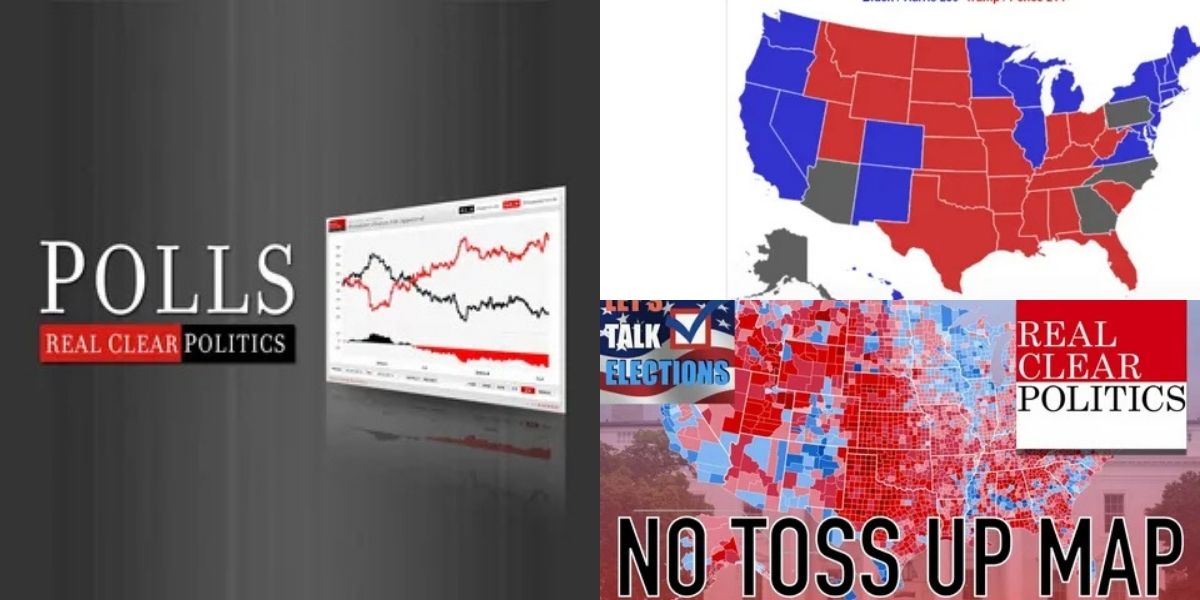
Real Clear Politics Polls: If you’ve ever refreshed a polling page and felt your certainty swing with every new datapoint, you’re not alone. Polls are designed to measure opinion, but the way we consume them often turns measurement into a mood. That’s why real clear politics polls—especially the RCP Average—have become a default reference point for campaigns, journalists, and engaged voters who want a cleaner, trend-based view rather than a constant stream of disconnected snapshots.
This guide is built to be practical. You’ll learn how the RCP Average is constructed, why a simple average can be both a strength and a vulnerability, how to read margins of error without fooling yourself, and how to talk about polling in a way that’s accurate, credible, and useful—whether you’re writing analysis, making content, or simply trying to understand what’s happening.
What “Real Clear Politics Polls” Are and Why People Rely on Them
At its core, real clear politics polls function as a highly visible polling hub that organizes many public surveys into topic pages—job approval, favorability, issue questions, and election matchups—so readers can see the latest releases and a running average in one place. The Real Clear Politics Polls value proposition is convenience, comparability, and an easy way to track direction over time without memorizing dozens of pollsters or hunting across separate press releases.
That “one-stop” structure matters because polling data is inherently noisy. Any single poll can be an outlier due to sampling variance, survey mode, or timing; an aggregation page reduces the temptation to treat one result as destiny. Polling educators routinely emphasize the advantage of aggregation for dampening day-to-day noise, even while warning that aggregators differ in how they build their averages.
How the RCP Average Works: Simple by Design, Easy to Audit
The defining feature of real clear politics polls is the way RealClearPolitics describes its approach to averaging: once polls are included, the site takes a straight, unweighted average rather than applying “black box” adjustments. That makes the number easy to understand, easy to reproduce, and easy to debate—because you can focus on which polls are in the mix and how recent they are.
“We do not weight our polls. We take a straight average of the polls that we include.”
This design choice has a real upside for readers. If you want transparency, an unweighted average is conceptually simple: every included poll counts equally, and the “argument” becomes about inclusion criteria rather than hidden weighting. RealClearPolling’s own explainer frames averaging as a way to effectively increase respondents and reduce error compared to following any single pollster in isolation.
What You’re Actually Looking At on RealClearPolitics Poll Pages
When you open real clear politics polls, you’re usually seeing three layers at once: a list of recent surveys, an “average” line summarizing the included polls, and navigation to related topics like job approval, party favorability, and “direction of country.” Those topic hubs are part of why the site is so frequently cited; it’s not just a single election page, but a catalog that allows quick comparisons across indicators that often move together.
It’s also important to recognize that the poll page is not only an “Real Clear Politics Polls average”—it’s a context tool. Many readers glance at the topline and leave, but the real analytical power comes from scanning who sponsored the poll, what mode was used, sample size, likely-voter vs registered-voter screens, and field dates. In practice, the “poll list” is as informative as the average because it lets you see whether movement is broad-based or driven by one or two new releases.
Poll Basics That Change How You Read Any Average
A polling average is only as meaningful as your grasp of what polls can and cannot do. Professional polling guidance stresses that pre-election polls are estimates, not forecasts, and that they can differ from outcomes due to sampling error, response challenges, and turnout modeling—especially in close races where small errors matter a lot.
RealClearPolling’s explainer also highlights a common misunderstanding: margin of error applies to each candidate share, not just the lead, and interpreting “outside the margin” requires careful thinking. The same explainer offers a rule-of-thumb approach to thinking about “outside the margin” that underscores the bigger point: poll reading is probabilistic reasoning, not scoreboard watching.
Why Averages Often Beat Individual Polls for Trend Tracking
If you want to understand movement rather than momentary jitter, real clear politics polls are appealing because the average reduces the influence of a single outlier. That aligns with standard polling advice: don’t overreact to one survey, because you can’t know if it’s “right” until more data arrives—so the safer approach is to look across multiple polls and focus on trends.
There’s also a statistical intuition here that non-specialists can use: averaging tends to smooth random variation. MIT’s overview on polling interpretation explicitly notes that such averages can “smooth out” variations that exist in any given sample, which is why aggregation became a mainstream habit for election watchers over the last two decades.
The Hidden Judgment Call: Which Polls Get Included in the Average
The main critique of real clear politics polls isn’t usually the math—simple averages are easy. The critique is the selection layer: deciding what gets included. RealClearPolitics acknowledges that judgment is involved in which polls go into its average, even while emphasizing that it does not weight once included.
This is where serious readers should slow down. If you want to evaluate the average responsibly, don’t ask only “what’s the number?” Ask “what’s in the number?” Track field dates, frequency of releases, and whether any pollster is appearing repeatedly in a short window. If a big change in the average follows one new poll, the right interpretation is not “the race shifted overnight,” but “the average is currently sensitive to a limited sample of recent inputs.”
RealClearPolitics vs Weighted Aggregators: What “Different” Really Means
A useful way to think about real clear politics polls is that RCP optimizes for simplicity and auditability, while other aggregators often optimize for modeling sophistication. As UVA’s polling guidance notes, RealClearPolitics reports a simple average treating polls the same, while other aggregators may weight by past accuracy, sample size, or recency.

Here’s the practical implication: an unweighted average can be more “legible” to everyday readers, but it can also be more sensitive to the mix of pollsters currently publishing. A weighted approach can reduce the impact of low-quality or historically biased pollsters—yet it can introduce opaque assumptions that readers can’t easily verify. Neither approach is automatically superior; the key is matching the tool to your goal: transparency, or modeled correction.
| Approach | How it works | Strengths | Trade-offs | Best use case |
|---|---|---|---|---|
| Simple, unweighted average (RCP-style) | Includes a set of polls, then averages them equally | Easy to understand, easy to replicate, easy to debate | Sensitive to which polls are included and when they’re released | Fast trend-checking and transparent discussion of inputs |
| Weighted poll average (common elsewhere) | Weights polls by factors like recency, sample size, or pollster track record | Can downweight weaker polls and reduce “noisy” spikes | Requires assumptions that may be hard to audit | When you want a curated estimate and accept model complexity |
Margin of Error, Nonresponse, and the Errors People Forget to Count
One reason real clear politics polls can feel confusing is that people treat margin of error as the full error. Professional guidance emphasizes that margin of error captures only sampling error, while other problems—nonresponse bias, unrepresentative samples, turnout mis-modeling—can be decisive and are harder to quantify.
This matters most when the race is close, because “small” polling errors are politically huge. AAPOR’s polling accuracy guidance explains how errors can arise from response rates, sampling methods, and late-deciding voters, and it stresses that polls should be interpreted cautiously—especially when the topline is within a narrow band.
House Effects and Methodological Differences: Why Pollsters Disagree
If you follow real clear politics polls closely, you’ll notice certain pollsters tend to run a bit higher for one party or the other. That pattern is often described as a “house effect,” and while it can reflect bias, it can also reflect consistent methodological choices—mode (online vs phone), weighting strategy, likely-voter modeling, or question wording. Polling educators note that systematic error sources matter alongside sampling error, including question wording and sample representativeness.
The key is to treat pollster differences as signals to investigate, not excuses to dismiss. When you see a poll that “doesn’t match” others, ask what’s different about the method or timing rather than assuming it’s wrong. And when you see multiple polls moving together, that’s more likely to be real movement—especially if the polls differ in sponsor and mode.
Swing-State Polls: How to Read Them Without Getting Whiplash
State polling is where real clear politics polls become both most valuable and most dangerous for casual readers. Valuable, because state pages let you see multiple surveys in one place; dangerous, because state polls often use smaller samples and can be more volatile. UVA’s guidance reminds readers that smaller samples tend to have larger margins of error and that single-poll obsession is “not time well spent” when races are tight.
Professional polling guidance also notes that state polling has sometimes missed in recent cycles, and that errors can be driven by factors like who responds and how likely voters are modeled. The smart approach is to treat swing-state averages as probabilistic indicators: they tell you where the race stands given current assumptions, not where it must end.
Approval Ratings, Favorability, and the “State of the Union” Indicators
Many readers think real clear politics polls are only about head-to-head matchups. In reality, one of the most useful parts of the ecosystem is the “State of the Union” style polling: job approval, favorability, party images, and issue sentiment. These indicators can shift before election matchups do, and they can explain why campaigns change strategy even when horse-race numbers look stable.
The analytical advantage of these indicators is that they often have clearer interpretation rules. Approval and favorability are still estimates with methodological variance, but they’re less sensitive to third-party assumptions and “who would you vote for today” framing. If you want to write credible analysis, using these alongside election polls can help you avoid overfitting your narrative to a single head-to-head series.
How to Use Real Clear Politics Polls for Credible Analysis, Not Hot Takes
The biggest upgrade you can make in how you use real clear politics polls is to treat the average as a starting point, then do a quick diagnostic scan of the inputs. Check field dates first, then look at whether the most recent poll is an outlier, then ask whether the direction is consistent across multiple pollsters. That three-step habit keeps you from confusing “new data” with “new reality.”
If you publish content using polling averages, borrow language from professional polling guidance: describe polls as snapshots, emphasize uncertainty, and focus on trends rather than point estimates. AAPOR explicitly warns against treating polls as predictions, and it explains why even properly conducted polls can differ from outcomes. If you build that humility into your analysis, your content reads as expert—not hedged, but responsible.
Red Flags That Often Signal a Misread of the Polling Landscape
A common failure mode with real clear politics polls is treating a one- or two-point change as proof of a “surge.” In close races, tiny movements can be statistical noise or normal sampling variation, and professional poll guidance emphasizes that there are multiple sources of error beyond what the margin of error suggests.

Another red flag is selective trust: believing polls you like and dismissing polls you don’t. UVA’s commentary captures the psychology bluntly—people take solace in favorable polls and try to debunk unfavorable ones—and that bias pushes readers into unreliable interpretations. The antidote is consistency: evaluate methodology and trend alignment the same way regardless of which side you prefer.
Practical Scenarios: How the Same Average Can Tell Different Stories
Consider a situation where the real clear politics polls average looks stable for weeks. One story is “nothing is changing.” Another story is “movement is happening, but it’s offsetting.” For example, one subgroup might be moving toward a candidate while another moves away, producing a flat topline. Without crosstabs and subgroup trend tracking, the average can hide meaningful shifts underneath.
Now consider the opposite scenario: the average moves sharply in a few days. That can be genuine change, but it can also be the math reacting to a short burst of new polls, especially if older polls rolled off and a few new ones came in at once. Averages are most informative when you combine them with a sense of cadence—how frequently polls are being fielded and how much of the average is driven by the last week versus the last month.
Misconceptions That Keep People From Understanding Polls
One misconception is that “within the margin of error” means a tie. In reality, it means uncertainty is high enough that the lead is not statistically decisive; it does not mean both candidates have equal support or equal probability of winning. Polling guidance repeatedly emphasizes that margin of error is only one part of uncertainty and that polls are estimates, not forecasts.
Another misconception is that an average is immune to bias. AAPOR notes that polling averages can still be inaccurate if the distribution of included polls shares a common bias or if the electorate shifts after surveys are conducted. The correct mental model is “averages reduce random noise,” not “averages remove all error.”
How to Write About RealClearPolitics Polls Without Losing Credibility
If you’re producing commentary, the most professional way to frame real clear politics polls is to separate measurement from meaning. Measurement is the number and the inputs. Meaning is what the number suggests about persuasion, turnout, and coalition strength—and that’s where you should be careful. When you state conclusions, attach them to trends and to multiple indicators (approval, favorability, generic ballot) rather than a single head-to-head line.
Also, be explicit about what you don’t know. Polling is not designed to tell you why people changed their minds unless the survey includes issue and motivation questions; it’s designed to estimate current preference under a particular sampling and weighting setup. When you write with that clarity, you sound like someone who understands polling as a discipline, not someone using polls as a weapon.
Conclusion
Used well, real clear politics polls can be one of the most efficient ways to track political trends without drowning in daily noise. The RCP Average is transparent by design, and that transparency is a feature: it encourages readers to look at inputs, field dates, and consistency across pollsters instead of outsourcing judgment to a hidden model.
Used poorly, the same pages can turn into a dopamine loop—refreshing, reacting, and narrating every wiggle as a turning point. The fix is straightforward: treat averages as signal filters, remember that polls are estimates (not predictions), and focus on patterns that persist across time, indicators, and methodologies. That mindset won’t just make you more accurate—it will make your analysis more valuable to everyone reading it.
FAQs
The questions below are written for people who want quick clarity without losing nuance. They assume you’re using real clear politics polls as a trend tool, not as a substitute for understanding uncertainty or the limits of survey measurement.
If you want the fastest upgrade, focus on the habit behind every answer: look at the average, then look at the inputs, then interpret the trend with humility about what polls can’t tell you.
What is the RCP Average on real clear politics polls?
The RCP Average on real clear politics polls is a straight, unweighted average of the polls RealClearPolitics chooses to include, designed to be simple to understand and easy to audit.
Does RealClearPolitics weight pollsters by accuracy or sample size?
No—RealClearPolitics has publicly emphasized that it does not weight included polls and instead takes a simple average once a poll is included in the mix on real clear politics polls.
Why do polling averages sometimes move after one new poll?
Polling averages can move after one new poll if the set of included polls is small, if older polls drop off, or if the new poll is meaningfully different—so the right move on real clear politics polls is to check field dates and the poll list before assuming public opinion shifted overnight.
Are polls “predicting” the election when they show a candidate ahead?
No—professional guidance stresses that polls are estimates of what respondents would do if the election were held today, and they can differ from outcomes because of turnout modeling, sampling challenges, and late movement, which is why real clear politics polls should be read as trend indicators rather than predictions.
What’s the best way to use real clear politics polls without being misled?
Use real clear politics polls to track direction over time, avoid overreacting to single polls, and interpret close margins with caution—because uncertainty comes from more than the reported margin of error and can include systematic sources of bias.